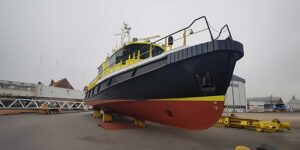


The company in this case study is a European tugboat operator. It aims to provide the best service to its clients, with flexibility, efficiency, and safety at the core of its towing operations. To achieve this, it is essential that the tugboats are maintained in top condition.
This study outlines the challenges the company faced, why it chose Lamers System Care B.V.’s sustainable Ultrasonic Anti-Fouling systems, and highlights the results achieved.
The tugboats operate almost exclusively in saltwater, making them highly susceptible to marine growth. It is crucial that the powerful engines are efficiently cooled.
The tugboat in this case study suffered for years from heavy fouling in the seawater inlets, filters, and coupling pipes. This meant that the cooling system had to be cleaned regularly—a costly and time-consuming process. Downtime caused by this cleaning meant the vessel could not operate and therefore generated no revenue.
The company had tested several Marine Growth Prevention Systems (MGPS) on its vessels. Some systems reduced fouling slightly, but the problem persisted. After inconsistent results, it was concluded that no suitable solution had yet been found.
A notable observation was the presence of large mussels in the coupling pipes, which the seaweed filter could not catch. How could so much fouling occur behind the filter? The photo shows the inside of a coupling pipe, behind a valve.
Bacteria and other organisms are carried by the flow of the cooling system. The filter acts as a sieve but does not capture these microscopic particles. For example, mussel larvae pass through the filter holes with the seawater and attach to the inside of a coupling pipe, where they then grow into adult mussels.
The ultrasonic technology developed and refined by Lamers System Care B.V. is used in various sectors to clean objects or surfaces and combat marine growth.
Ultrasonic vibrations put a surface into resonance. This creates a pattern of rapidly alternating pressure: sound waves. During negative pressure, microscopic bubbles form and then implode under the positive pressure of the wave, destroying single-celled bacteria.
The attachment of these bacteria to a surface is the first stage of fouling, known as biofilm—a slimy green layer. This biofilm forms the basis for larger organisms such as mussel larvae, barnacles, or tube worms. By preventing the formation of the biofilm layer, these organisms have no opportunity to attach to surfaces such as the inside of a coupling pipe or filter.
The Control Unit
The system can be connected to both 110–240 VAC and 12–24 VDC. When both are connected, the system automatically selects VAC (shore power) and switches to VDC in case of failure. If battery voltage drops too low, the system switches off to protect the battery.
The control unit is programmed so the transducers always run the same program. This causes the transducers to emit pulses every few seconds at frequencies between 20 and 60 kHz, inaudible to the human ear. After completing 20 different frequencies, the program restarts.
The Transducers
The transducers consist of a piezo element housed in an injection-molded casing. The transducer is then screwed into a pipe adapter or transducer ring using Molykote BR2+ (industrial grease) and secured with strong two-component epoxy.
In this case, the pipe adapters and transducer rings were glued to a coupling pipe, filter, and seawater inlet. Because the bottom of the transducer itself is not glued directly to the surface, but the ring or adapter is, the transducer uses this as leverage to deliver strong pulses.
This is much stronger than a transducer glued directly to a surface, resulting in better sound transmission. The surface resonates more effectively, enhancing the ultrasonic effect. The pipes amplify the effect, similar to a trumpet.
Where the tugboat previously experienced fouling in the coupling pipes and filters after just three months, it has been at least 13 months since the installation of the Ultrasonic Anti-Fouling System with no such issues.
The installation ensures that the tugboat’s engines and auxiliary systems remain efficiently cooled with seawater without any loss of cooling capacity over time. This extends the life of the engines and other systems and reduces maintenance of the cooling system. As a result, fewer dry-dock periods are required for this tugboat.
By choosing the sustainable Ultrasonic Anti-Fouling system, the company also takes a significant step towards environmental responsibility.
Filters During Two Different Inspections (December 2019 and September 2020)
The only fouling visible is a remnant that existed before the system was installed. As shown in the photos, this growth has not worsened over the ten-month period.